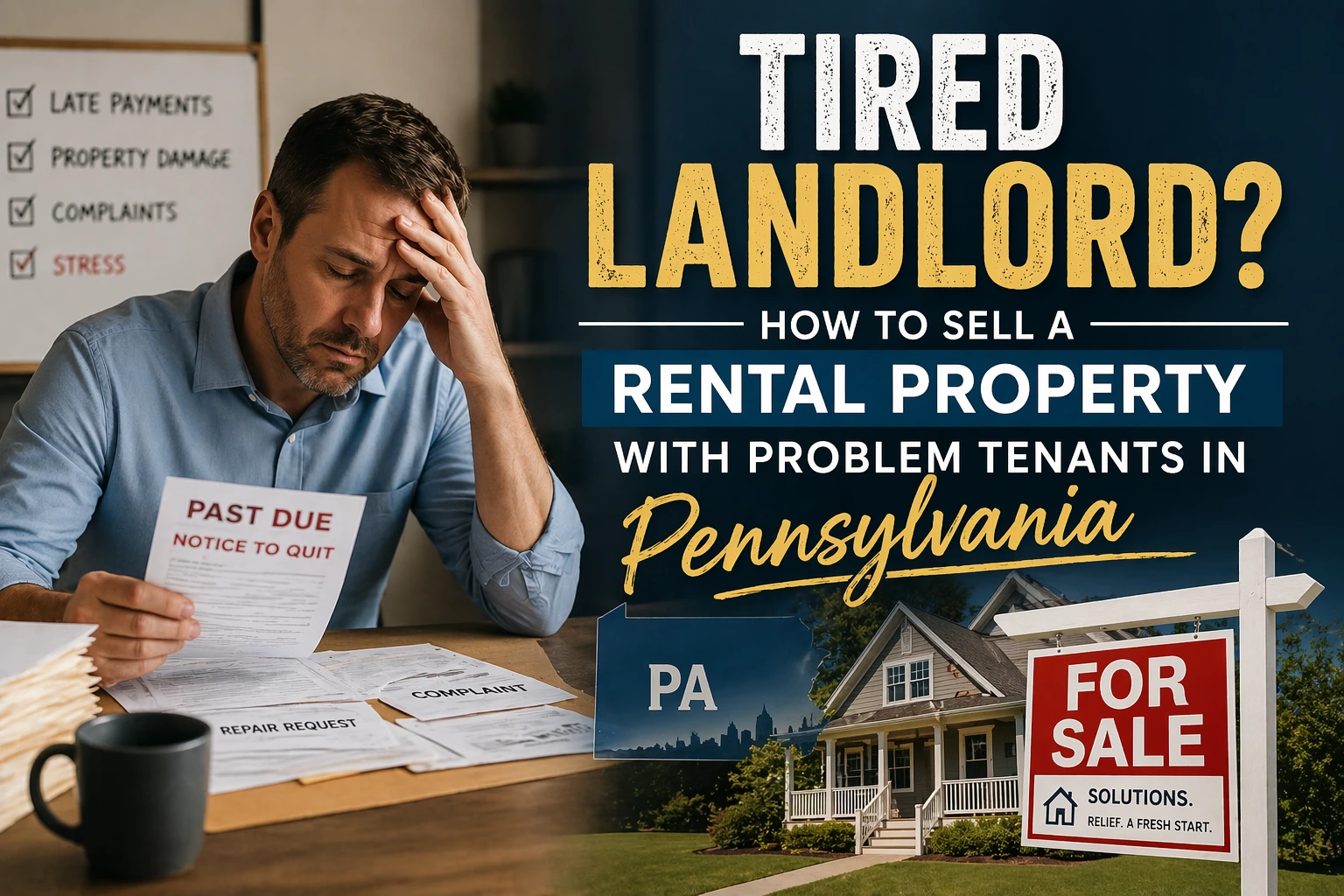
It’s 2 AM and your phone is buzzing. Again. The tenant in your rental property is texting about a clogged toilet—the third plumbing issue this month. You lie awake calculating the numbers: they’re two months behind on rent, the property needs a new HVAC system, and you just paid another $400 to fix the damage from their “small gathering” last weekend.
You never planned to become a full-time property manager. Maybe you inherited the rental. Maybe you couldn’t sell your old house when you moved and decided to rent it out. Maybe you bought it as an investment, expecting passive income that turned out to be anything but passive. Whatever the path, you’ve arrived at the same place: exhausted, frustrated, and ready to be done.
But selling a rental property with tenants—especially problem tenants—feels impossibly complicated. Do you have to evict them first? Can you even sell with someone living there? Will any buyer want a property with tenants who don’t pay rent or take care of the place? What about Pennsylvania’s landlord-tenant laws?
Here’s what tired landlords across Pennsylvania are discovering: you can sell your rental property without evicting your tenants first, without making repairs, and without the months of headaches that come with traditional sales. Cash buyers like ROI National specialize in purchasing tenant-occupied properties, handling the complications so you can walk away clean.
This guide covers everything you need to know about selling a rental property with problem tenants in Pennsylvania: your legal obligations, your options, and the fastest path to freedom from landlord stress.
What You’ll Learn
- Signs You’re a Tired Landlord Ready to Exit
- Common Problem Tenant Situations
- Pennsylvania Landlord-Tenant Law Basics
- Why Traditional Sales Are Difficult with Tenants
- Your Options for Selling a Tenant-Occupied Property
- The Fastest Path: Selling to a Cash Buyer
- What Happens to Tenants When You Sell
- Calculating the True Cost of Being a Landlord
- Why Pennsylvania Landlords Choose ROI National
- Frequently Asked Questions
- Next Steps
Signs You’re a Tired Landlord Ready to Exit
Landlord burnout is real. In our experience working with property owners across the Philadelphia area, these are the warning signs that it’s time to consider an exit:
- You dread seeing your tenant’s number on your phone
- Rent collection has become a monthly battle
- You’re spending more on repairs than you’re earning in rent
- You’ve stopped making improvements because “what’s the point”
- The property is affecting your sleep, your relationships, or your health
- You’re subsidizing the tenant’s housing from your own pocket
- You’ve thought about just walking away and letting the bank take it
- Every interaction with the tenant leaves you angry or anxious
- You can’t remember the last month rent was paid on time and in full
- You’ve been “meaning to deal with it” for months or years but keep putting it off
If several of these resonate, you’re not failing as a landlord—you’re recognizing that this investment no longer serves you. The question isn’t whether to exit, but how to exit in a way that protects your finances and sanity.
Common Problem Tenant Situations
“Problem tenant” covers a wide range of situations. Understanding what you’re dealing with helps determine the best path forward.
Non-Payment of Rent
The most common issue. Your tenant pays late, pays partial amounts, or stops paying altogether. Each month they don’t pay, you’re covering the mortgage, taxes, and insurance out of pocket. The debt accumulates, but collecting it—even with a court judgment—is often impossible.
The math problem: If rent is $1,500/month and your carrying costs are $1,800/month, every month of non-payment costs you $1,800 in expenses plus $1,500 in lost income = $3,300 per month in the hole.
Property Damage and Neglect
Some tenants don’t take care of the property. Holes in walls. Broken fixtures. Pet damage. Neglected maintenance that turns into major repairs. By the time they leave, the property needs extensive work—often far exceeding any security deposit.
We’ve seen properties where tenants caused $20,000-$50,000+ in damage. Recovering that through legal action is theoretically possible but practically difficult if the tenant has no assets.
Lease Violations
Unauthorized occupants, pets when none are allowed, running a business from the property, excessive noise complaints from neighbors, or illegal modifications. These violations create liability for you as the property owner and can affect your relationship with neighbors and local authorities.
Hoarding Situations
Hoarding creates health and safety hazards, potential code violations, and massive cleanout costs when the tenant eventually leaves. These situations often worsen over time and can result in structural damage, pest infestations, and fire hazards.
Illegal Activity
Drug activity, illegal businesses, or other criminal conduct on your property creates serious legal exposure for you as the owner. In Pennsylvania, properties can potentially be subject to civil forfeiture in extreme cases. Even without forfeiture, police activity, neighbor complaints, and legal liability make these situations urgent.
Tenants Who Won’t Leave
The lease ended months ago, but they’re still there. Or you’ve given proper notice to terminate, but they refuse to vacate. These “holdover” tenants know the eviction process takes time and use that to their advantage, staying rent-free while you pay the bills.
Pennsylvania Landlord-Tenant Law Basics
Understanding Pennsylvania’s landlord-tenant laws helps you see why eviction isn’t always the simple solution it seems—and why selling to a cash buyer can be the better path.
The Pennsylvania Eviction Process:
Step 1: Notice to Quit. Before filing for eviction, you must give the tenant written notice. For non-payment of rent, Pennsylvania requires a 10-day notice. For lease violations, 15-30 days depending on the violation. For month-to-month tenancies without cause, 15 days if less than one year of tenancy, 30 days if more.
Step 2: File a Complaint. If the tenant doesn’t leave after the notice period, you file a Landlord-Tenant Complaint with the local Magisterial District Court. Filing fees range from $100-$200+.
Step 3: Hearing. A hearing is scheduled, typically 7-15 days after filing. Both parties present their case. The tenant can raise defenses (habitability issues, retaliation claims, procedural errors). If you win, you receive a judgment for possession.
Step 4: Appeal Period. The tenant has 10 days to appeal to the Court of Common Pleas. If they appeal, the process starts over at the higher court level—adding weeks or months.
Step 5: Order for Possession. If no appeal, you request an Order for Possession. The tenant gets another 10 days to vacate.
Step 6: Writ of Possession and Eviction. If the tenant still doesn’t leave, you request a Writ of Possession. The constable or sheriff schedules the actual eviction—physically removing the tenant and their belongings. This can take additional weeks depending on the court’s backlog.
Total Timeline:
Best case scenario (no appeal, cooperative courts): 6-8 weeks from filing to physical eviction. Realistic scenario (tenant appeals or courts are backed up): 3-6 months. Worst case (multiple legal maneuvers, court delays): 6-12+ months.
Total Cost:
- Filing fees: $100-$200
- Attorney fees (if using one): $1,500-$5,000+
- Constable/sheriff fees: $200-$500
- Lost rent during process: $3,000-$18,000+ (depending on rent amount and timeline)
- Property damage discovered after eviction: $2,000-$30,000+
- Storage of tenant belongings (if required): $500-$2,000
- Repairs and cleaning before re-renting: $3,000-$15,000+
Conservative total: $10,000-$50,000+ in direct costs and lost income to evict one problem tenant and prepare the property for the next one.
Why Traditional Sales Are Difficult with Tenants
Listing a tenant-occupied property with a real estate agent creates a host of complications that most landlords don’t anticipate.
Showing Challenges:
Pennsylvania law requires you to give tenants reasonable notice before entering the property—typically 24 hours for showings. Problem tenants may refuse access, make the property unpleasant for potential buyers, or simply not be home when showings are scheduled. We’ve heard of tenants deliberately sabotaging showings with bad smells, messes, or hostile behavior toward buyers.
Condition Issues:
Financed buyers expect properties to pass inspection. With a problem tenant, the property may have deferred maintenance, damage, or code violations that make traditional financing difficult. FHA and VA loans have particularly strict requirements that tenant-occupied properties often can’t meet.
Buyer Pool Limitations:
Most retail buyers want an empty house they can move into. The pool of buyers willing to purchase a tenant-occupied property is much smaller—mostly investors who expect a significant discount for taking on the tenant situation.
Lease Complications:
If your tenant has an active lease, the lease transfers with the property. The new owner inherits the tenant and must honor the lease terms. This makes the property less attractive to most buyers and complicates negotiations.
Non-Paying Tenants During Sale Process:
While your property sits on the market for 3-6 months, your non-paying tenant continues not paying. You’re losing thousands per month while waiting for a traditional sale to close.
Your Options for Selling a Tenant-Occupied Property
You have several paths forward. Each has trade-offs in time, money, and stress.
Option 1: Evict First, Then Sell
How it works: Complete the eviction process, make repairs, clean the property, then list it for sale.
Timeline: 3-12 months for eviction + 1-2 months for repairs + 3-6 months for sale = 7-20 months total
Cost: Eviction costs ($5,000-$15,000+) + repairs ($5,000-$30,000+) + carrying costs during entire process + agent commissions (5-6%)
Best for: Landlords with time, money for repairs, and properties in desirable areas where retail sale prices significantly exceed investor prices
Reality check: Most tired landlords don’t have the energy or resources to manage a 12-18 month process while continuing to deal with the problem tenant
Option 2: Wait for Lease to End, Then Sell
How it works: Don’t renew the lease, give proper notice, hope the tenant leaves voluntarily, then sell.
Timeline: Depends on lease end date + 30 days notice + hope they actually leave
Risk: Many problem tenants don’t leave when the lease ends. You’re right back to eviction, having waited months for nothing.
Best for: Tenants who are problems but generally cooperative, where you have reason to believe they’ll leave voluntarily
Option 3: Negotiate “Cash for Keys”
How it works: Offer the tenant money to leave voluntarily. Typical offers range from one to three months’ rent.
Pros: Faster than eviction, avoids legal costs, tenant may leave property in better condition if they’re getting paid
Cons: Feels unfair to pay someone who owes YOU money. Not all tenants will negotiate. Some take the money and still don’t leave (though a well-drafted agreement with immediate consequences helps).
Best for: Situations where the cost of cash-for-keys is less than the cost of eviction + lost rent + repairs. Often makes mathematical sense even when it feels wrong.
Option 4: Sell to Another Investor
How it works: List the property as an investment property with tenants in place. Target other landlords or investors.
Reality: Investors are sophisticated buyers. They’ll heavily discount for problem tenants because they’re calculating eviction costs, repairs, and lost rent themselves. The discount may exceed what you’d lose by handling the tenant first.
Best for: Properties with performing tenants (paying rent, taking care of property) where investors see ongoing income rather than a problem to solve
Option 5: Sell to a Cash Home Buyer (Like ROI National)
How it works: Sell the property as-is, with tenants in place, to a cash buyer who specializes in these situations. The buyer handles eviction, repairs, and tenant issues after closing.
Timeline: As fast as 7-14 days from accepting offer to closing
Cost: No commissions, no closing costs, no repair expenses, no additional carrying costs while waiting for eviction
Best for: Tired landlords who want out now, properties with problem tenants, situations where the emotional cost of continuing outweighs the financial difference between retail and cash sale prices
The Fastest Path: Selling to a Cash Buyer
For most tired landlords with problem tenants, selling to a cash buyer like ROI National is the fastest, simplest path to freedom. Here’s why:
We Buy with Tenants in Place: You don’t have to evict anyone. We purchase the property with existing tenants—paying, non-paying, cooperative, or hostile. The tenant situation becomes our responsibility at closing, not yours.
No Repairs Needed: Properties with problem tenants often have deferred maintenance and damage. We buy as-is. You don’t spend money fixing up a property you’re selling.
No Showings to Coordinate: You don’t have to fight with tenants about access or clean up before showings. We evaluate the property quickly (often one visit) and make our offer.
Certainty of Close: We pay cash. No financing contingencies, no appraisal requirements, no deals falling through because a lender won’t approve a tenant-occupied property.
Speed Stops the Bleeding: Every month you own the property costs money. A sale that closes in 14 days versus one that takes 6 months saves thousands in carrying costs—especially when rent isn’t being collected.
You Walk Away Clean: At closing, the property is no longer your problem. No more 2 AM phone calls. No more collecting rent. No more tenant drama. You have cash and your freedom.
The Trade-Off:
Cash buyers pay less than retail buyers. Typically 70-85% of what an empty, renovated property would sell for. But here’s what tired landlords discover: after factoring in the costs of eviction, repairs, lost rent during the process, agent commissions, and their own time and stress, the net difference is often much smaller than expected. And for many landlords, the peace of mind is worth far more than any dollar difference.
What Happens to Tenants When You Sell
Many landlords feel conflicted about selling with tenants in place—even problem tenants. Understanding what happens helps ease that concern.
Leases Transfer with the Property:
Under Pennsylvania law, when you sell a rental property, existing leases transfer to the new owner. The new owner steps into your shoes as landlord and must honor the lease terms. This protects tenants from being immediately displaced by a sale.
What Cash Buyers (Like ROI National) Typically Do:
- For non-paying tenants: We begin the legal process to enforce the lease or initiate proper eviction proceedings. We follow all Pennsylvania landlord-tenant laws.
- For performing tenants: We often keep good tenants in place, especially if we’re holding the property as a rental. A paying tenant is an asset.
- For tenants willing to leave: We frequently offer cash-for-keys arrangements to facilitate smooth transitions. Many tenants prefer cash in hand and a fresh start.
- For all tenants: We treat people with respect. Even problem tenants are human beings in difficult situations. Professional, respectful handling benefits everyone.
Your Obligations:
As the selling landlord, you typically need to provide the buyer with copies of existing leases, tenant contact information, and security deposit information. Security deposits transfer to the new owner, who becomes responsible for returning them according to Pennsylvania law.
Disclosure:
Be honest with your buyer about the tenant situation. Disclose non-payment history, known damage, and any ongoing disputes. Cash buyers like ROI National expect these issues—we specialize in them. Hiding problems only creates legal complications later.
Calculating the True Cost of Being a Landlord
Many landlords underestimate the true cost of holding onto a problem property. Let’s do the math.
Monthly Carrying Costs (Property Value: $250,000):
- Mortgage payment: $1,400 (principal + interest)
- Property taxes: $400
- Insurance: $150
- Utilities (if tenant isn’t paying): $200
- Maintenance reserves: $200
- Total monthly carrying cost: ~$2,350
If Rent Isn’t Being Collected:
You’re out $2,350/month in expenses plus the $1,500/month rent you should be receiving = $3,850/month in negative cash flow.
Over an Eviction Timeline:
- 3-month eviction: $11,550 in losses
- 6-month eviction: $23,100 in losses
- 12-month eviction: $46,200 in losses
Plus Eviction Costs:
- Legal fees and court costs: $3,000-$5,000
- Constable/sheriff: $300-$500
Plus Post-Eviction Repairs:
- Property damage repair: $5,000-$30,000+
- Cleaning and trash removal: $1,000-$5,000
- Updates to re-rent: $3,000-$10,000
Total Cost of “Waiting It Out”:
A 6-month eviction process with moderate repairs: $23,100 (lost income/carrying costs) + $4,000 (legal) + $15,000 (repairs) = $42,100
This is the real comparison. If a cash buyer offers $30,000 less than theoretical retail value, but you avoid $42,000 in eviction costs and losses, you’re actually $12,000 ahead—plus you have your time and peace of mind back.
Why Pennsylvania Landlords Choose ROI National
When you’re ready to exit a rental property with problem tenants, you need a buyer who understands the situation and can move efficiently. Here’s why tired landlords across the Philadelphia area trust ROI National:
We Specialize in Tenant-Occupied Properties: Buying rentals with tenants—including problem tenants—is a core part of our business. We’re not surprised by non-payment, damage, or difficult situations. We’ve seen it all.
We Handle the Tenant Situation: After closing, the tenant becomes our responsibility. We manage evictions, cash-for-keys negotiations, and tenant transitions. You walk away clean.
We Buy As-Is: No repairs, no cleaning, no updates. We purchase properties in any condition and factor repair costs into our offer. Your problem property is our opportunity.
Speed to Close: We can close in as little as 7 days. When you’re bleeding money every month on a non-paying tenant, speed matters. The faster we close, the more you save.
Cash Means Certainty: No financing contingencies, no appraisal requirements, no lender who won’t approve a tenant-occupied property. When we make an offer, we close.
We Buy Portfolios Too: If you have multiple rental properties you want to exit, we can purchase your entire portfolio in a single transaction. One closing, one check, total freedom.
Local Philadelphia-Area Expertise: We’re headquartered in Southampton, Bucks County. We know Philadelphia-area rental markets, property values by neighborhood, and Pennsylvania landlord-tenant law.
No Fees, No Commissions: We pay all closing costs. No agent commissions means more of your equity stays with you.
10+ Years, 500+ Homes: Since 2015, we’ve purchased over 500 properties throughout the tri-state area. Our 50+ verified Google reviews (4.9+ rating) reflect our commitment to fair, professional transactions.
Frequently Asked Questions
Can I sell my rental property without evicting the tenants first?
Yes. You can sell a tenant-occupied property at any time. The lease transfers to the new owner, who becomes the landlord. Cash buyers like ROI National specialize in purchasing properties with tenants in place—including problem tenants. You don’t have to go through the eviction process before selling.
Will ROI National evict my tenants after buying the property?
We handle each situation appropriately. For non-paying or problem tenants, we typically pursue legal remedies or negotiate departures. For performing tenants who pay rent and care for the property, we often keep them in place. Either way, tenant management becomes our responsibility after closing—not yours.
Do I have to give my tenants notice that I’m selling?
Pennsylvania law doesn’t require you to notify tenants that you’re selling the property. However, you may need to give notice before property showings or inspections. When selling to a cash buyer like ROI National, minimal showings are needed, reducing this issue.
What happens to the security deposit when I sell?
The security deposit transfers to the new owner at closing. You’ll provide documentation of the deposit amount, and the buyer assumes responsibility for holding it and returning it according to Pennsylvania law when the tenancy ends.
My tenant hasn’t paid rent in months. Can I still sell?
Absolutely. Non-payment is one of the most common reasons landlords sell to us. We factor the tenant situation into our offer and handle collection or eviction after closing. You stop losing money immediately at closing.
How fast can you close on a property with tenants?
We can close in as little as 7 days if you’re ready to proceed. Most transactions close within 14-21 days. The timeline depends on title work and your preferences, not on resolving the tenant situation first.
Will I get less money selling with tenants in place?
Cash buyers pay less than retail buyers would for an empty, renovated property—typically 70-85% of retail value. However, when you factor in the costs of eviction, repairs, lost rent, and agent commissions, the net difference is often much smaller than expected. Many landlords come out ahead by selling quickly.
What if my tenant damages the property before closing?
We buy properties as-is, which includes any tenant-caused damage. Our offer accounts for the property’s current condition. If significant damage occurs between offer and closing, we can discuss adjustments, but generally we proceed as planned.
Can I sell if I have multiple rental properties?
Yes. We purchase single properties and entire portfolios. If you’re exiting landlording entirely, we can structure a single transaction for all your properties—one negotiation, one closing, one check.
What if my tenant has a long-term lease?
Leases transfer with the property. The new owner must honor existing lease terms. We’re experienced in purchasing properties with active leases and factor this into our evaluation. Having a lease in place doesn’t prevent a sale.
Next Steps: Get Your Free Cash Offer
Being a landlord was supposed to be an investment, not a second job. If problem tenants have turned your rental property into a source of stress, financial loss, and sleepless nights, you have options. Selling to a cash buyer lets you exit on your terms: no eviction battle, no repairs, no months of carrying costs while the traditional sale process drags on.
The math often surprises tired landlords. When you add up the true costs of evicting, repairing, and selling traditionally versus accepting a cash offer today, the cash sale frequently comes out ahead—and you get your life back.
ROI National has helped hundreds of Philadelphia-area landlords exit problem properties. We understand tenant situations, we move fast, and we handle complications so you don’t have to.
Ready to explore your options? Contact ROI National today for a free, confidential consultation. Call 215-278-9944 (available 7 days a week), fill out our online form at roinational.com, or email info@roinational.com.
Here’s what happens when you reach out: We’ll have a brief conversation about your property, the tenant situation, and your goals. If selling makes sense, we’ll evaluate the property (one quick visit) and provide a cash offer within 24-48 hours. You can accept, decline, or use the offer to evaluate your options—no pressure, no obligation.
Your rental property doesn’t have to keep draining your time, money, and energy. Let’s find you a way out.
About the Author
Allen Leyman is a Principal and Licensed Real Estate Professional at ROI National, headquartered in Southampton, PA (Bucks County). With over 10 years of experience in real estate investment and cash home buying across Pennsylvania, New Jersey, and Delaware, Allen specializes in helping landlords exit rental properties—including those with difficult tenant situations. He and the ROI National team have purchased over 500 properties throughout the tri-state area, many of them tenant-occupied rentals. Allen understands the financial and emotional toll of problem tenants and takes pride in offering landlords a straightforward path to freedom.